In this chapter, we will learn about the various types of storms that exist on our planet. One characteristic that all of these weather systems share is that they produce one or more clouds extending into the upper troposphere. Figure 8.1 displays a series of satellite images showing each storm type from space. The clouds that make up these systems are highly reflective and, as a result, are very visible from this overhead vantage point. The largest storm system found on our planet is called a mid-latitude cyclone. These systems are, on average, about 2000 km (1250 mi) in width and tend to form in a zone between 30° and 60° of latitude. In mid-latitude cyclones, the clouds organize themselves along two or more fronts (which separate warm and cold air masses) that extend from the storm’s center of rotation. One of the dominant fronts, known as a cold front, extends from the storm’s center towards the southwest. The other front, called a warm front, generally has a west/east orientation.
The tropics are home to very powerful storms known as tropical cyclones or hurricanes. Hurricanes can be very destructive, especially when they make landfall. Tropical cyclonic systems form over warm tropical oceans, mainly during the summer and fall, have sustained wind speeds greater than 118 kph (74 mph), and produce heavy rainfall. The structure of a hurricane consists of numerous thunderstorm clouds organized in many swirling bands that circulate around a center of rotation. The average size of a hurricane is about 550 km (340 mi) across.
Thunderstorms are the smallest storm systems found on our planet. The size of an individual storm ranges from several kilometers to over 50 km (several miles to 30 mi) in diameter. Thunderstorms can exist in isolation or as organized clusters, often associated with mid-latitude cyclones or hurricanes. Their distribution is also quite widespread, extending from the equator to the high latitudes.
The remaining sections in this chapter will expand our discussion of the various storms that dominate the Earth’s weather.
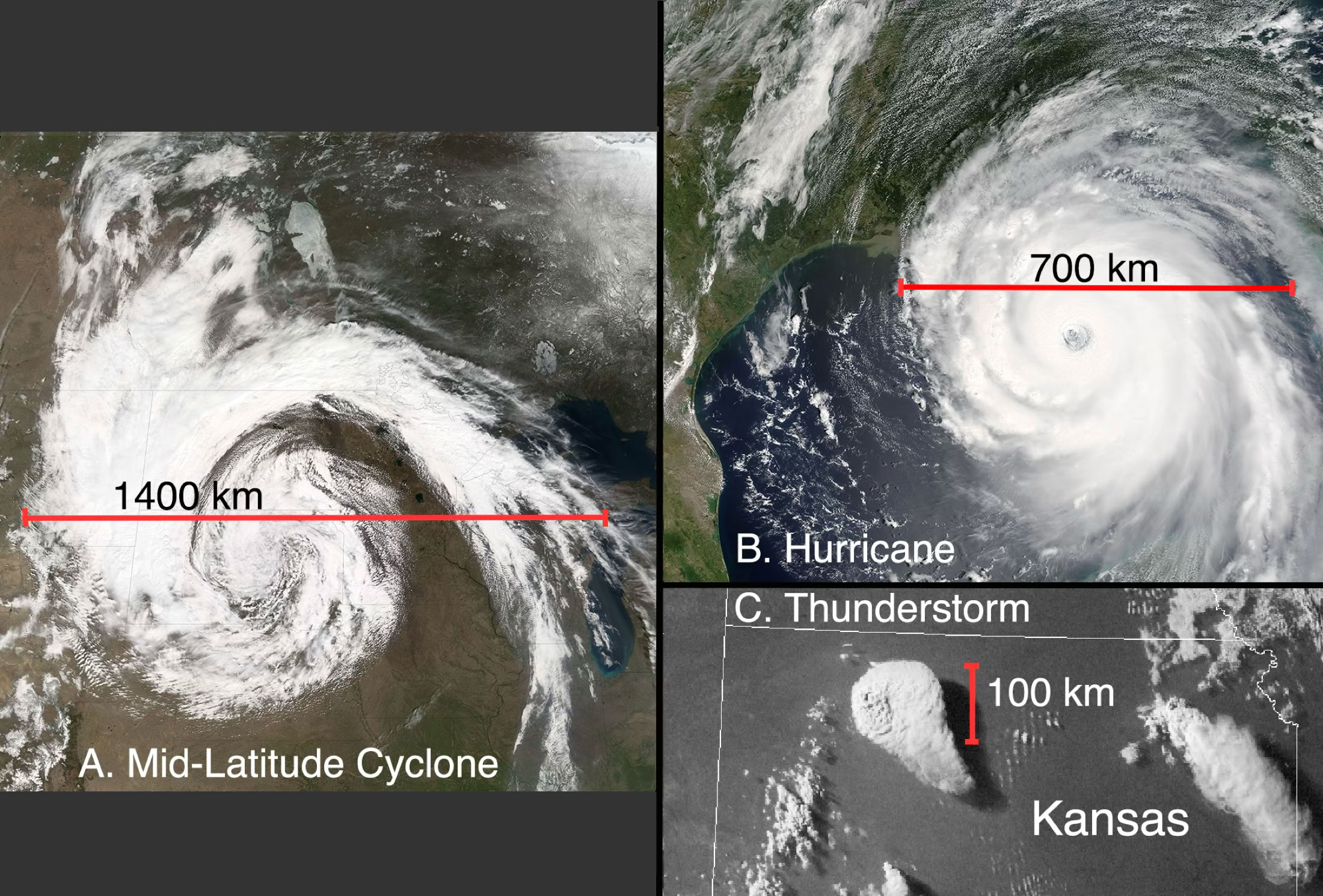
FIGURE 8.1 Three different types of storms dominate the Earth’s climate system. The largest of these storms is the mid-latitude cyclone(A).The diameter of mid-latitude cyclones can vary from 200 km (125 mi) to over 4000 km (2500 mi). Hurricanes are intense storms that develop primarily in the tropics and subtropics(B). Hurricanes can range in diameter from 150 km (93 mi) to 1500 km (930 mi). Thunderstorms are the smallest storms found on our planet, with the average size of a single cell being about 25 km (16 mi) in diameter(C). Thunderstorms can occur in isolation, in organized groups of storm cells, or as part of larger storm systems, such as mid-latitude cyclones and hurricanes. Image Copyright: Michael Pidwirny, Original Images: NASA and NOAA.